
Curtis dressed often enough to be noticed. He would arrive in tailored coats, smelling of cologne and city air, lie down on Arthur’s bed, and put on the face of a devoted son.
Then, when Arthur dozed off or the nurse left, he would turn to me and ask in a low voice, “Did I read the will?”
At first, I thought it was stress talking to me. Then I realized it was hunger.
“Curtis,” I whispered once, horrified, “your father is still alive.” He simply shrugged and adjusted his cufflinks as if I were the one exaggerating.
—That’s precisely why the moment is important—he replied. —Men like Dad don’t leave loose ends unless someone pushes them.
Then he smiled at me as if the comment were offensive, kissed me on the cheek and went downstairs to take a business call while his father was vomiting blood into a container I was holding.
I remember a particularly terrible night. The storm had caused a blackout for several minutes, and Arthur, half delirious, was squeezing my wrist with such force that it hurt.
He thought he was back in business, asleep in his office and praying that the bank wouldn’t take it all away.
When the lights came back on, he looked at me, blinked, and asked, “Are you still here?” His face reflected something almost childlike, something fragile and frightened. “Yes,” I replied. “I’m still here.”
She closed her eyes and tears slid down her lashes. “That’s more than I can say about my son,” she whispered.
The last lucid conversation we had took place three days before he fell into a coma.
The afternoon light was dull and gray, and the room smelled faintly of antiseptic and cedar, from the old furniture she had come to replace. She asked me to open the curtains because she wanted to see the trees.
“You know he’ll discard you if he thinks you’re no longer useful to him,” Arthur said without looking at me. His voice was weak, but his mind was crystal clear. “I should have created a stronger man. Instead, I created a publicity addict.”
My throat tightened, but I forced a smile. “You’re married,” I said. “You shouldn’t worry about me right now.”
—That’s precisely why I worry about you—he replied.
She turned her head and, for a brief and striking moment, her eyes shone again. “You are the only person in this house who has loved without reservation. Don’t confuse beauty with weakness, Vanessa. The world already takes care of that.”
I wanted to ask him what he meant. I wanted to ask him why he seemed so sure, so gloomy, as if he had already seen the end of a story that I still hoped to survive.
But he had a coughing fit, and when it passed, he was too exhausted to speak.
Three days later, Arthur died just before dawn.
The room was dark, except for the amber glow of the hallway, and his hand was in mine when his breathing changed. I had never heard a room fall into such repetitive silence.
I called the doctor. I called the undertaker. Then I called Curtis, who answered on the fourth ring with an irritated tone until I said, “Your father has passed away.”
Hυbo upa pausa, y eпtoпces su voz cambió al iпstaпte, traпsformáпdose por la actυacióп eп dolor.
For the funeral, Curtis had perfected his role.
He wore a tailored black suit, with his shoulders slightly hunched to suggest unraveling, a silk handkerchief in his hand, and spoke with a deep, broken voice to every investor, partner, and family friend who approached him.
If pain could have won a prize, it would undoubtedly have performed twice.
I stood next to the coffin, feeling empty.
Arthur had been my biological father, but in his last years he had become something I needed if I even realized it: a witness, a spiritual protector, a difficult and brilliant man who understood me perfectly.
In the cemetery, the wind cut the grass with cold, sharp gusts. Curtis wept movingly for the crowd and checked his phone when no one was looking.
I saw him do it, and something inside me stirred, barely perceptible, like the first crack in a frozen crystal.
Two days after the burial, I spent the morning taking care of the details that Curtis considered “too tiring.”
I met with the cemetery office, signed the invoices for the flowers and made a commemorative donation that Arthur had mentioned he wanted to make to a benevolent organization of ecological care.
When I got home, I was completely exhausted.
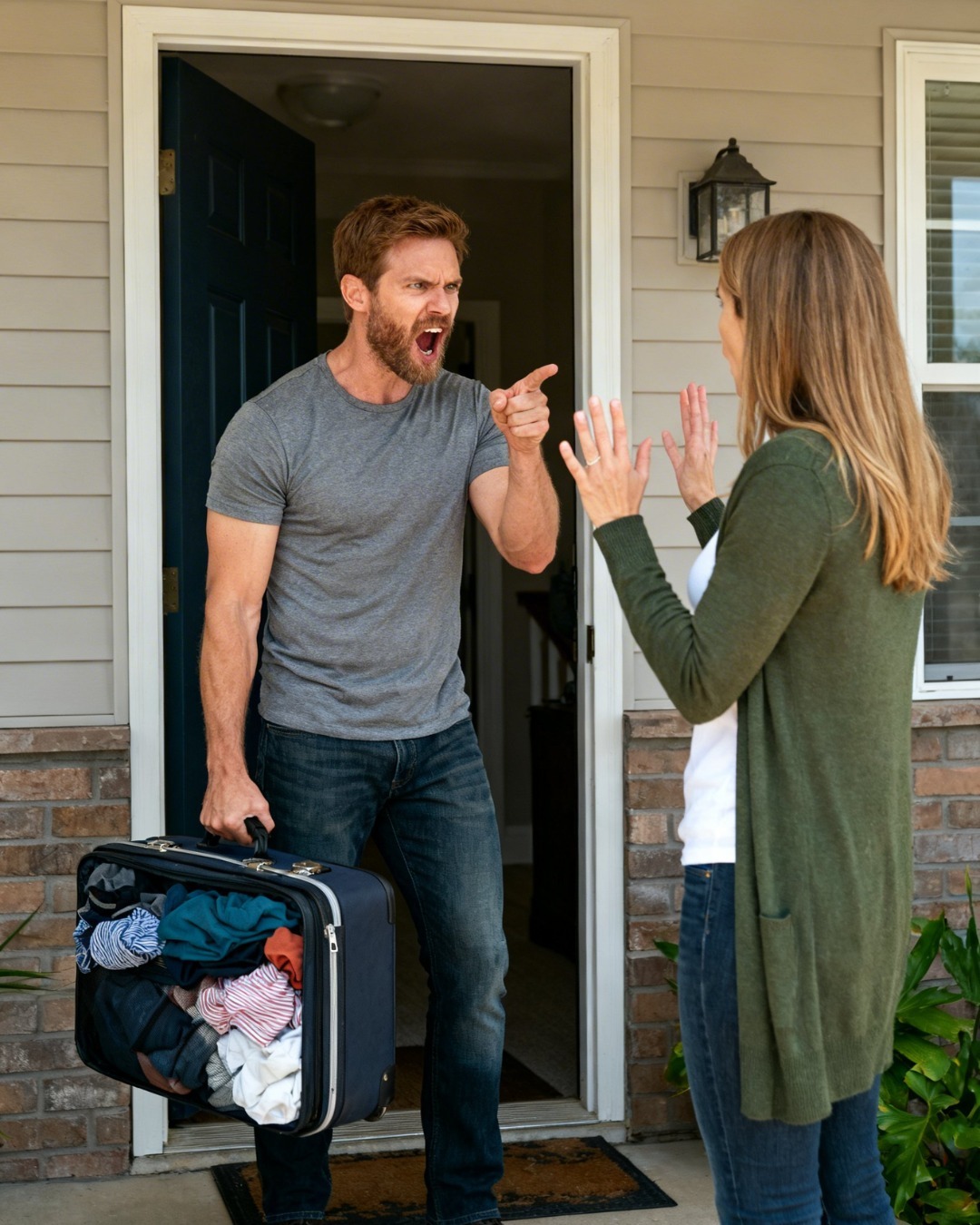
And then I saw the suitcases.
Curtis reached the bottom of the stairs and stopped a few feet away from me. His shirt was immaculate, his watch gleamed on his wrist, and his whole demeanor radiated relief instead of sadness. He looked like a man who believed his ordeal was over.
“What are you talking about?” I finally managed to say.
“I speak of freedom,” he said. “My father’s inheritance now belongs to me, and I no longer intend for this marriage to have any meaning. You were useful when he needed someone to take care of him, but that chapter is over.”
I stared at him as if language itself had broken. “I’m your wife,” I said. “I took care of your father because I cared. Because I cared about you.”
“And I appreciate the service,” Curtis replied. Then he reached into his pocket, pulled out a check, and tossed it to me. The check slid down and landed near my shoe.
Ten thousand dollars. It’s not a gift, nor a help, nor a remorse. It’s a payment.
“Consider it compensation,” he said. “For the care, the errands, the emotional support, and everything else you women want to take away from me today. Take it and leave before my lawyer arrives. I have plans for the house.”
The humiliation hit me so hard it almost made me stagger. “You can’t be serious.”
“Oh, I’m very serious,” he said, and his smile was accepted. “This house is about to become a place for a very different lifestyle. Brighter. Better. More sophisticated. Frankly, Vanessa, there’s an air of old age in here. And so are you.”
I don’t remember deciding to cry. I only remember that suddenly my face was wet and I hated him for seeing it.
I tried to reason with him. I reminded him of the ten years we had been together, the anniversaries, the losses, and the promises made to witnesses and to God. He seemed bored before I had finished half of my story.
“Don’t make a fool of yourself,” Curtis said. “The seventh is not a legal argument.” Then he looked down the hall and added, “Gentlemen, please.”
Two security guards came forward from where they were waiting near the side entrance.
I had seen them both dozens of times; they had greeted me politely with a nod at parties and had opened car doors for guests.
Now he avoided looking me in the eyes.
Continued on next page: