
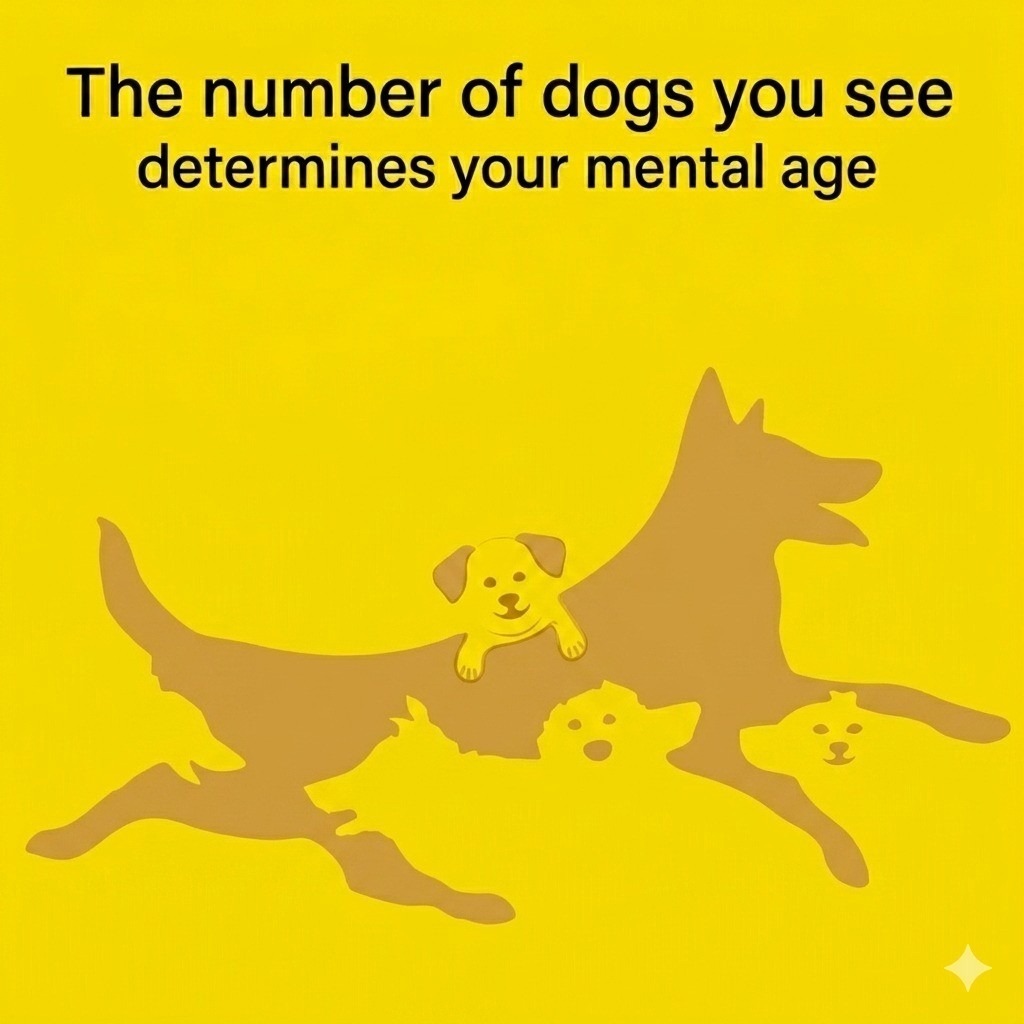
🤔The number of dogs you see in this picture determines your mental age👀 FULL ARTICLE IN THE FIRST COMMENT !!!⤵️
“The Number of Dogs You See Determines Your Mental Age” — A Closer Look at the Viral Illusion Everyone Is Talking About
“🤔 The number of dogs you see in this picture determines your mental age 👀 Full article in the first comment…”
If you’ve spent any time on social media, you’ve likely come across posts like this. They’re eye-catching, playful, and just mysterious enough to make you pause and look a little closer. At first glance, it seems like a simple game: count how many dogs you can find in an image, then scroll down to discover what your answer supposedly says about you.
Maybe you saw four dogs. Maybe seven. Maybe even more after looking carefully. And then comes the intriguing part—the claim that your answer reveals your “mental age.”
But can a visual puzzle really measure something as complex as mental age? And why do people see different numbers in the first place?
Let’s take a deeper, more thoughtful look at what’s really going on behind these viral illusions—and what your answer actually means (and doesn’t mean).
Why People See Different Numbers of Dogs
Images used in these puzzles are not random. They are carefully designed optical illusions that play with perception.
At first, you may notice a few obvious dogs—large, clearly outlined shapes. But as you continue to look, you might begin to see more:
Smaller dogs hidden within larger shapes
Outlines formed by shadows or overlapping lines
Faces or bodies suggested by negative space
Repeating patterns that resemble dog features
This layered design allows multiple interpretations. The image isn’t meant to have one obvious answer—it’s meant to invite exploration.
What influences what you see?
Several factors affect how many dogs you count:
How long you spend observing the image
Whether you focus on details or the overall picture
Your visual experience with puzzles or illusions
Your level of attention and patience at that moment
Two people can look at the same image and genuinely see different things—and both experiences are valid.
The Brain’s Love for Patterns
The reason these illusions work so well lies in how the human brain processes visual information.
Our brains are constantly trying to:
Recognize familiar shapes
Fill in missing details
Turn abstract patterns into meaningful objects
This ability is incredibly useful in everyday life. It helps us recognize faces, read expressions, and navigate our environment quickly.
But in illusions, this same strength can lead us to “see” things that are not explicitly drawn.
This phenomenon is closely related to pareidolia—the tendency to perceive recognizable shapes (like faces or animals) in random or ambiguous patterns. It’s the same reason people sometimes see animals in clouds or faces in objects.
Does Your Answer Really Reveal Your “Mental Age”?
This is where the viral claim becomes misleading.